7.2 Visiting the Designer Dashboard
To support the analysis of your learning design, the Learning Design Studio (LDS) provided the Designer Dashboard featuring visualisations such as pie charts and heatmaps to illustrate how learning tasks interact with the overall design. It offers summary statistics to help users quickly identify patterns and imbalances in their design. Building on these insights, the dashboard will provide targeted feedback to guide further enhancements.
🌟 For guidance on the learning tasks, refer to Chapter 2.6 - Task Taxonomy.
A quick recap about the 4 types of task categories:
Directed Learning, Exploratory Learning, Productive Learning, Reflective Learning
| How can we ensure that students engage with different types of learning tasks to optimize their learning experience? |
|
|
Figure |
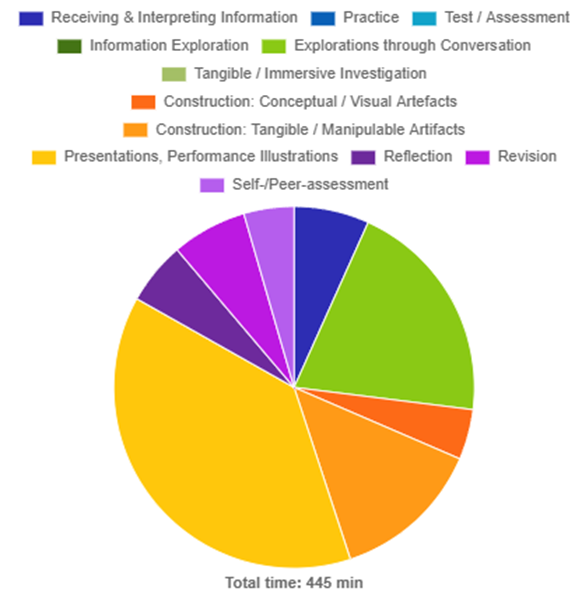
Distribution of time spent on learning task types:
This analysis focus on the time spent on learning task types. It shows the ratio of in-class to out-of-class activities. It also highlights the top task types through both text descriptions and color-coded segments in the pie chart, helping you quickly understand the overall distribution of learning tasks.
|
| How can we ensure a comprehensive student learning experience by providing a balanced range and frequency of different learning tasks? | |
|
Figure |
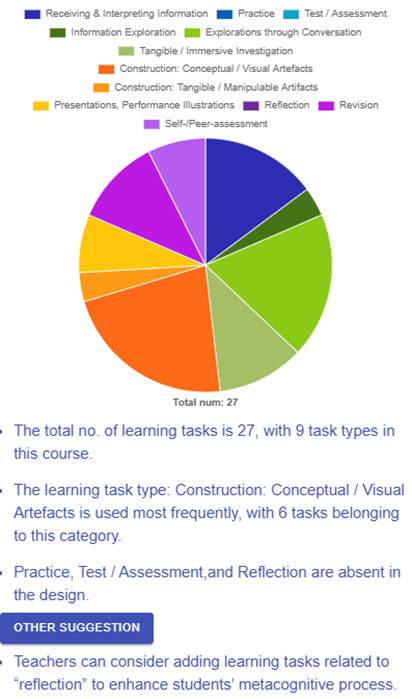
Distribution of number of learning task types:
Suggestion:
|
| How can we design our assessment strategy to foster a more holistic development of skills, ensuring we evaluate not just application, but also analysis, evaluation, and creation? | |
|
Figure
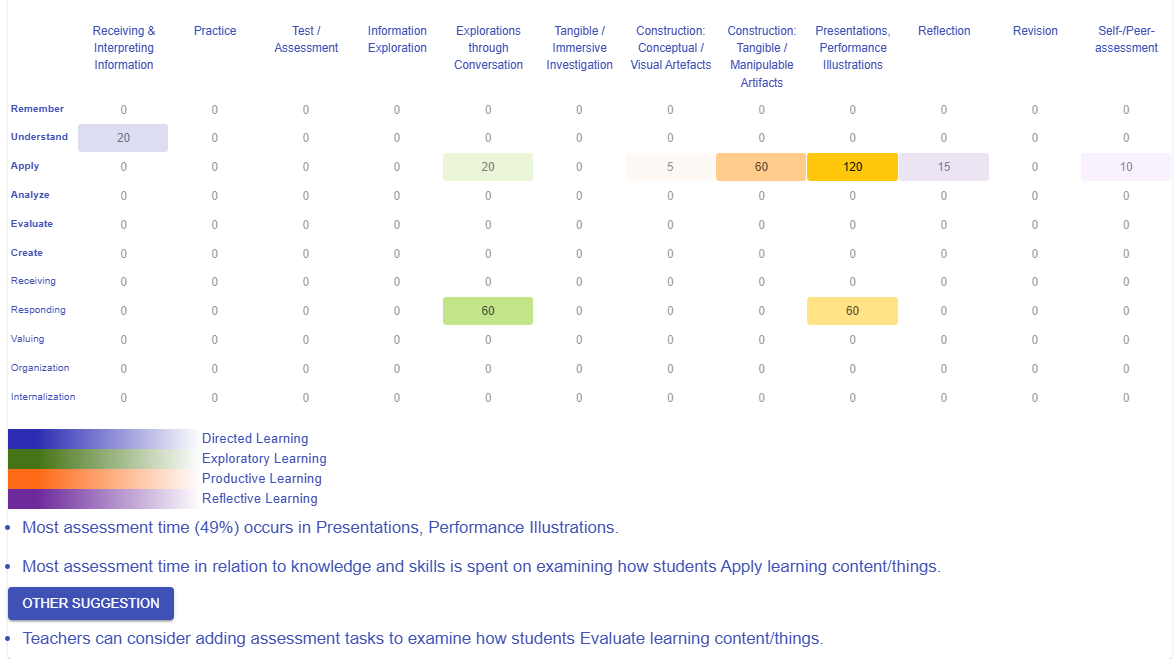
Heatmap of time spent on assessment tasks - LO level vs task category:
Suggestion:
|
|
| How can we ensure our use of social organization—individual, group, or whole class—is strategically matched to the cognitive demands of the task? | |
|
Figure
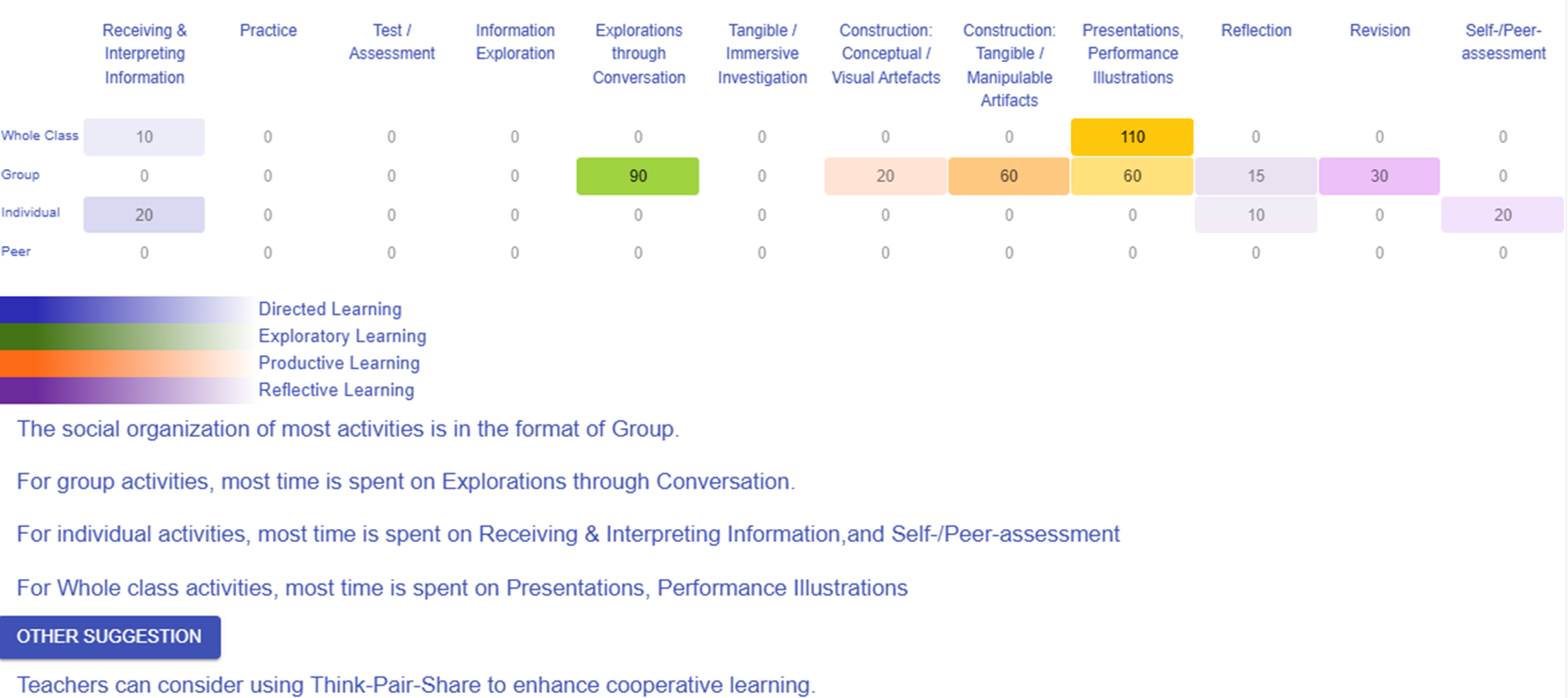
Heatmap of time spent on all tasks - social organization vs task type:
Suggestion:
This analysis examines how time is distributed across different task types within various social organization formats. It reveals which tasks dominate in each social setting and highlights opportunities to diversify engagement methods. |
|
|
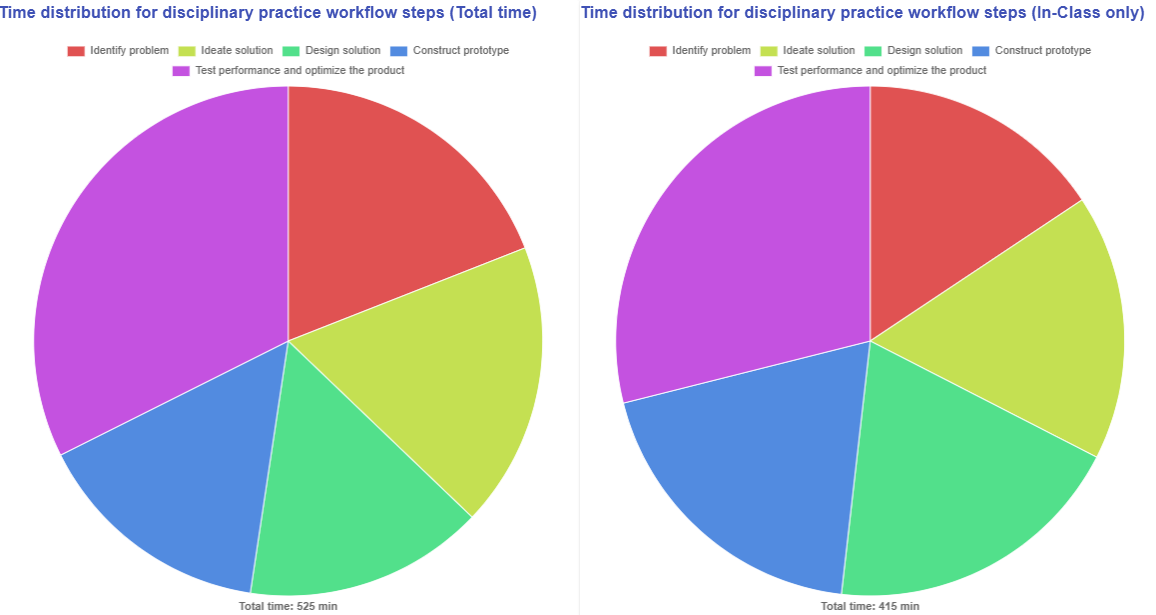
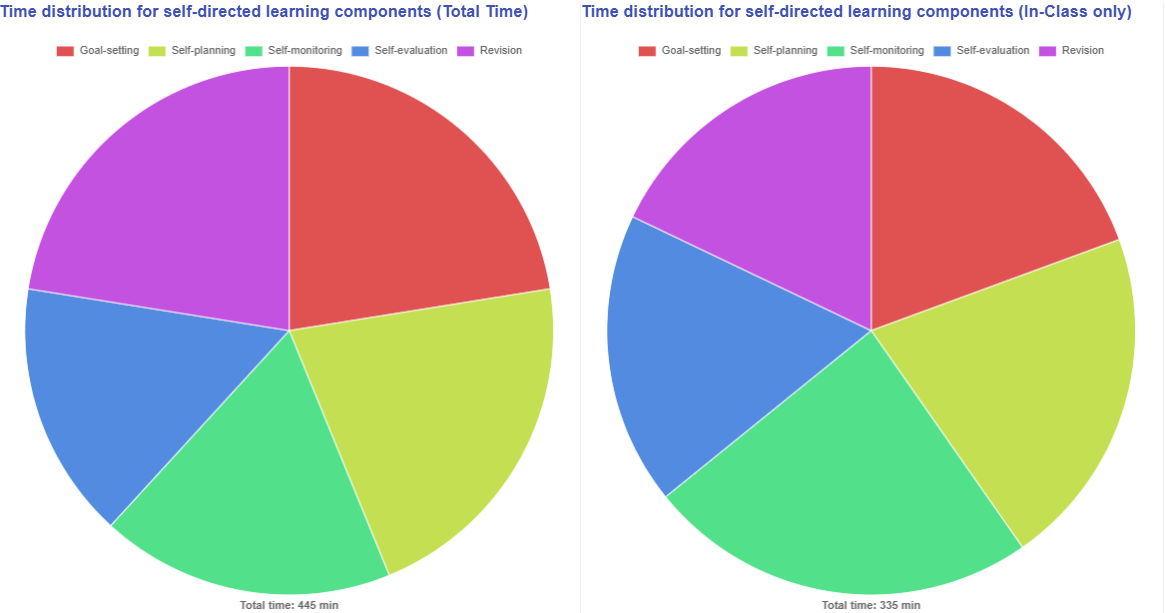
How do you organize your lesson time with respect to disciplinary practices and your chosen pedagogical approach? |
|
|
Figure
Figure
The two diagrams above illustrate how the workflow steps of disciplinary practice and the pedagogical focus of the chosen pedagogical approach are arranged within your learning design. Additionally, the dashboard shows both the total time allocated for all learning tasks and the specific time dedicated to in-class activities, helping to ensure that the out-of-class workload remains manageable. |
|